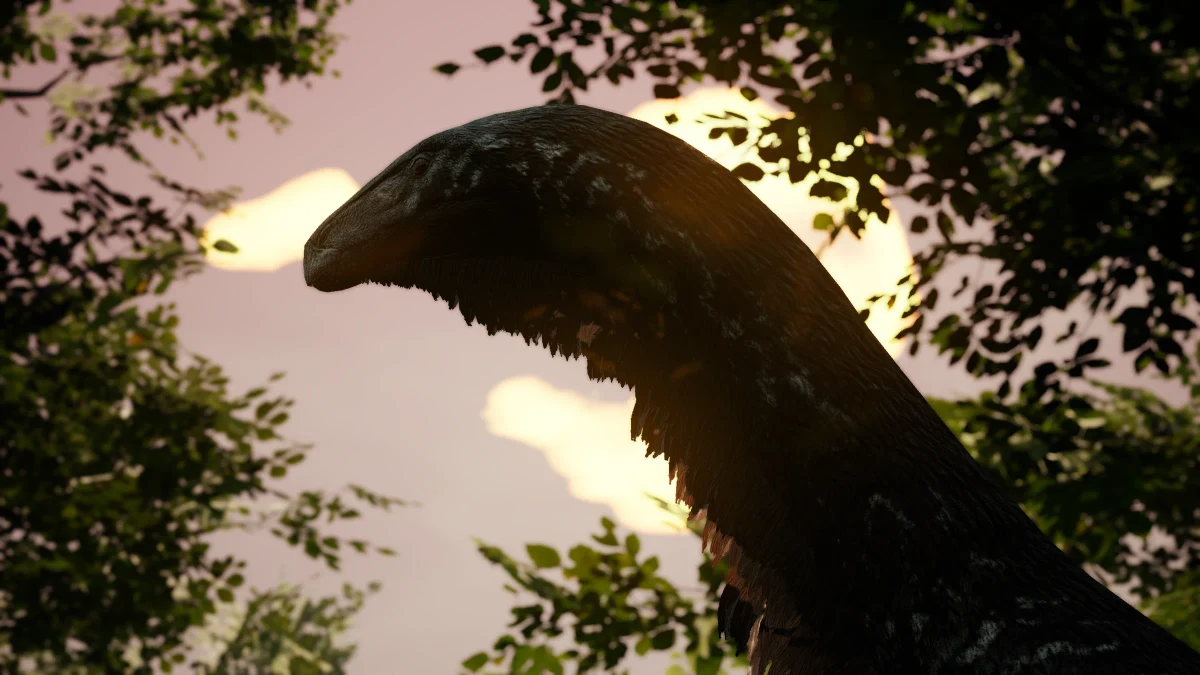
Our team has been hard at work in preparation for our beta test. Many profiles are past the concepting and rough draft phase, and some are even complete. In the meantime, feast your eyes on these profile snippets brought to you by Spyre, kc and Vishuni.
Therizinosaurus
- Smaller creatures are offered more grace, however, and may even be approached by especially curious Therizinosaurs. They might sniff and prod at these smaller guests, only deterred by fleeing, particularly fierce displays, or a painful nip. Some individuals will even poke their noses into burrows, sniffing around for any inhabitants and occasionally digging them up for entertainment.
- Deinonychus are welcome visitors due to their roles as sentries, cleaners, and even pest exterminators, permitted to hunt the smaller herbivores, such as Bagaceratops and Silesaurus, that feed on the Therizinosaur's coveted resources. For similar reasons, the company of Psittacosaurus is also enjoyed. Both Deinonychus weddings and Psittacosaurus colonies are permitted to nest in Therizinosaurus territories, but Deinonychus will be shooed away from eggs and small pouts due to their tendencies to scavenge and create mischief. Particularly bored Therizinosaurs may trail these smaller guests and observe their antics for entertainment. Should conflict arise between the two species, they will simply watch the chaos unfold from a distance, too unbothered to intervene.
Deinocheirus
- The first few months of a chick's life are spent on land. During this period, their mother introduces them to a fully terrestrial lifestyle, feeding off fresh grasses and berries instead of fish and clams. Juvenile chicks are bolder, wrestling and playing games of chase under their mother's watchful gaze. Those who stray too far are swiftly ushered back to her side. When a possible threat appears, chicks are quick to hide behind their mother, but soon gain enough confidence to investigate should their mother show no hostility.
- Chicks are finally introduced to water as they approach adolescence and their adult feathers grow in. While they may show nervousness at first, chicks take to their semi-aquatic nature like ducks to water. At this stage, gender becomes apparent, and behaviors start to differ. Young cobs become increasingly aggressive with one another, swatting at their siblings in an attempt to maintain a monopoly over resources. This fierce competition serves as a way for brothers to start building bonds and form duos, a behavior that eventually leads to the creation of a raft.
- Young pens are mild-mannered in comparison to their brothers, but are far from afraid to fight back when bullied. Adolescent sisters spend their time wandering together and playing, their bonds forming from constant socialization as they gradually decide who to pair off with. Some daughters may attempt to stick to their mother's side instead, hoping to join her bevy should she be solo.
Deinosuchus
- A nesting mother will listen carefully for the first chirps of her newborns, prompted to leave the water and climb onto the banks to greet them once they have broken the surface of their nests. She will carefully escort them to the safety of the water, whether by shepherding them beneath her massive belly or by carefully gathering them one by one into her jaws and taking them to the water herself.